


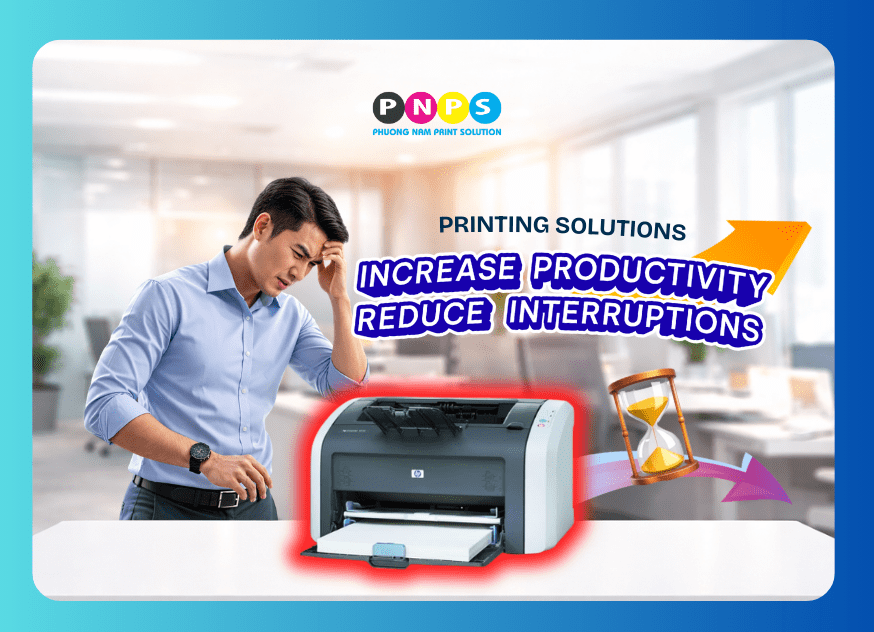
In business operations, organizations often focus most of their attention on major incidents that cause serious disruption. However, research in organizational behavior suggests that small, repeated work interruptions — known as micro-interruptions or tiny interruptions — are the factors that quietly erode productivity and create hidden losses over time.
A study from the University of California, Irvine found that after an interruption, employees take an average of 23 minutes and 15 seconds to return to their previous level of focus. Meanwhile, Harvard Business Review reports that knowledge workers may perform more than 1,000 context switches per day, spending hours each week simply regaining concentration after interruptions.
Most studies focus on interruptions caused by emails, notifications, or digital applications.
However, in real operational environments, there is another source of disruption that receives far less attention:
Printing systems.
Micro-interruptions: When a few minutes of disruption become hundreds of hours a year
- A printer jam during peak working hours.
- A printing station running out of toner without available supplies.
- A connection error preventing documents from being printed on time.
- A critical workspace with no backup printer available.
Each of these issues may seem minor. Yet within the flow of daily operations, they interrupt work processes, force employees to pause their primary tasks, delay other departments waiting for documents, and push workloads toward the end of the day.
Once the issue is resolved, employees still need additional time and focus to return to unfinished tasks and restore their working rhythm.
What makes these losses particularly problematic is that they rarely appear in formal reports. No financial statement includes a line item labeled “loss due to printing interruptions.”
Instead, these losses manifest in forms that are difficult to quantify:
-
Wasted time
-
Disrupted workflows
-
Employees performing tasks outside their expertise
-
Workload pressure accumulate toward the end of shifts
For organizations with multiple branches, factories, warehouses, or high printing volumes, these seemingly small issues can gradually become daily productivity drains if they are not properly designed and controlled from the beginning.
Designing printing systems with an operational mindset
When disruptions occur, many businesses choose to upgrade their equipment: newer machines, higher capacity, stronger configurations. However, a good device does not automatically create a reliable system.
If printing stations are not aligned with usage demand, if critical locations lack backup equipment, if maintenance only occurs after failures appear, or if internal staff must troubleshoot technical issues themselves, interruptions will continue to happen.
In such cases, businesses need a structured printing solution designed around real operational workflows.
When backup systems exist at critical points, a malfunction no longer means work must stop.
When maintenance is proactive rather than reactive, the probability of failure decreases significantly.
When a dedicated technical team is available, internal staff no longer have to step outside their roles to handle technical problems.
This is the foundation of a system-level printing solution for enterprises.
PNPS – Enterprise printing solutions at the system level
Phuong Nam Printing Solutions (PNPS) approaches printing not as individual devices but as part of the overall operational system.
Before proposing any solution, the team conducts a thorough assessment of the organization’s actual conditions, including: printing volume at each location, environmental conditions, output requirements at every printing location, previous printing performance, he company’s expectations for its printing system.
Based on this analysis, PNPS implements a comprehensive solution that includes:
-
Designing a printer network aligned with the company’s operational structure
-
Selecting device configurations that match real usage demands
-
Positioning backup machines and supplies at critical locations
-
Implementing proactive periodic maintenance
-
Providing a dedicated technical team to receive and resolve incidents
With this approach, the likelihood of system failures is reduced from the design stage. When issues do occur, downtime is minimized thanks to backup resources and specialized support. Most importantly, employees no longer need to troubleshoot technical issues outside their professional responsibilities.
Among the many factors that can disrupt business operations, PNPS can help printing becomes a controllable variable when it is properly designed and managed.
👉 For more information, please contact:
📞 Hotline: 028 6660 9898
🏢 Head Office: 72 Le Thanh Ton, Sai Gon Ward, Ho Chi Minh City
🌐 Website: https://printsolution.vn/home_vn/